
Along the way.
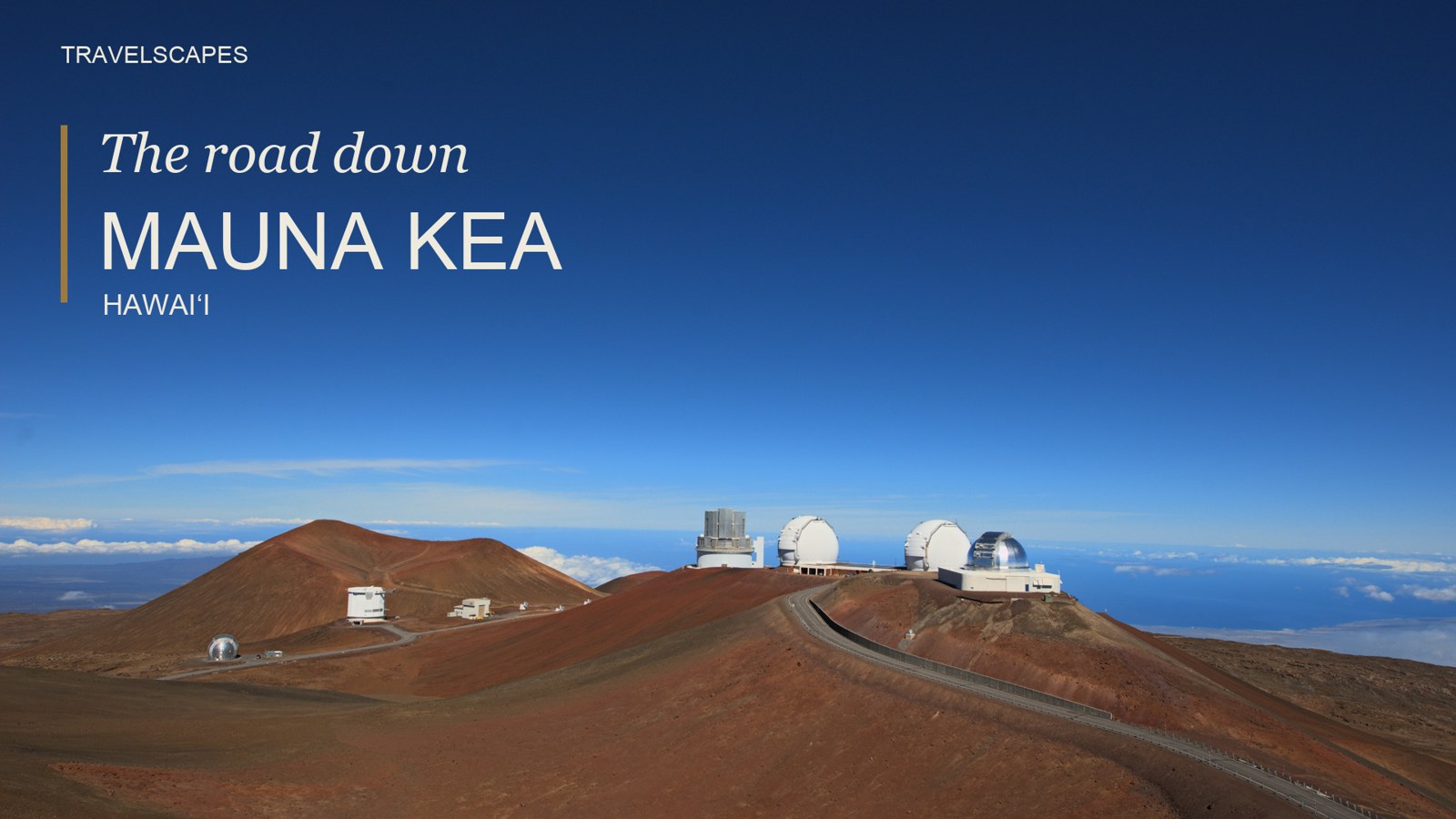
The film begins with a short climb toward the observatories before the road turns downhill. Historical scenic footage, with original road sound between the spoken passages.
Original photography and footage by Sven Bannuscher. Narration uses a synthetic voice.
Chapters
Read the narration transcript
This journey begins with a short climb toward the observatories. From there, we turn back down Mauna Kea, on Hawaiʻi Island. Filmed in summer, the road leads from the high volcanic landscape toward the visitor station. The paved road curves uphill between the observatories. White domes stand on separate rises, with dark volcanic ground around them. We are still climbing through this part of the journey. Soon, we will turn our attention to the road down. The first bends open a longer view of the mountain. A guardrail follows the edge of the road, while the ground falls away beyond it.
From this direction, the route we climbed is a succession of ridges, rather than a single summit. Notice the rounded forms on either side of the road. Mauna Kea began as a shield volcano, but later eruptions added cinder cones and rugged lava flows. Those later features help give its upper slopes their irregular outline. The asphalt makes a dark line across the brown slopes. At each turn, the near ridge blocks the distance for a moment, then lets it appear again. The view changes with the road, even while the weather stays clear. By this point, the observatories are behind us. The surface is gravel, and the edges of the
road are less sharply defined. Loose stone sits close to the track. The quieter pace gives us time to see the texture of the ground. A cloud layer stretches beyond the bare slopes. Nearby, the cinders are sharply visible. Farther away, the land becomes a broad shape against the clouds. There is very little vegetation in this part of the view, so the contours are easy to follow. There is another chapter to this mountain beneath the dry landscape. Geological evidence records repeated glaciation on Mauna Kea during earlier cold periods.
The clear, stony slopes we see today are one moment in a much longer history. Mauna Kea has deep cultural and spiritual significance for Native Hawaiians. The observatories and access road are only part of its story. A scenic drive can show us the surface of the mountain, while reminding us how much lies beyond a visitor’s view. Lower down, small plants begin to return beside the road. The wide, bare ground gives way to patches of grass and shrubs. It is a modest change at first, but it marks our return toward a different part of the island. The visitor station brings this filmed descent to its close.
Continue with the ascent and observatory walk, linked below. Thank you for traveling with Travelscapes. See the road. Hear the story.