
Along the way.
These historical scenic views follow the road and observatory area. They do not show a hike to Mauna Kea’s exact summit or entry into the observatories. The mountain has deep cultural and spiritual significance for Native Hawaiians.
Original photography and footage by Sven Bannuscher. Narration uses a synthetic voice.
Chapters
Read the narration transcript
Above the clouds, another side of Hawaiʻi comes into view. This is Mauna Kea. Welcome to Travelscapes. See the road. Hear the story. Today, we are following the road up Mauna Kea, on the island of Hawaiʻi. Filmed in summer, this journey takes us from the mountain road to the observatories high above the clouds. We will take time to look around, before following a little of the road back down. At first, the landscape still holds some green. Grass and low shrubs soften the volcanic slopes, and
the road gives us a familiar line to follow. But the mountain is already changing the scale of the view. The further we climb, the more space there seems to be between us and the rest of the island. The paved road gives way to gravel. Pale dust, dark rock, and warm brown earth begin to dominate the picture. It is a different kind of Hawaiian landscape from the beaches and tropical forests. Here, the journey is shaped by the mountain itself, with bends and gradients that ask us to slow down. The route keeps turning across the slope. One bend reveals a wall of dark volcanic rock; another opens a glimpse of cloud beyond the edge of the road.
Rather than rushing through the climb, we can follow these changes at the pace of the drive. Each corner gives us a slightly different view of the mountain. Mauna Kea rises to roughly four thousand two hundred metres above sea level. That makes it the highest point in Hawaiʻi. The road does not take us to the exact summit, but it brings us into the high mountain landscape around the observatories. Even through a camera, the change in surroundings is striking. These slopes were built by volcanic activity. The rounded cinder cones and scattered rock record different chapters in the mountain’s history.
The upper landscape was also shaped by glaciers during past ice ages. It is a reminder that this tropical island has a much more varied story than its shoreline suggests. Look at the colours beside the road. The soil moves from grey and charcoal to rusty red and brown. Against that clear blue sky, even a simple curve becomes a strong shape. There is very little here to distract from the contours of the land, and that is part of what makes the view so compelling. By this stage, the vegetation has largely disappeared from the view. The mountain is reduced to a few strong elements: rock, soil, sky, and the line of the road. The upper slopes can seem simple at first, but
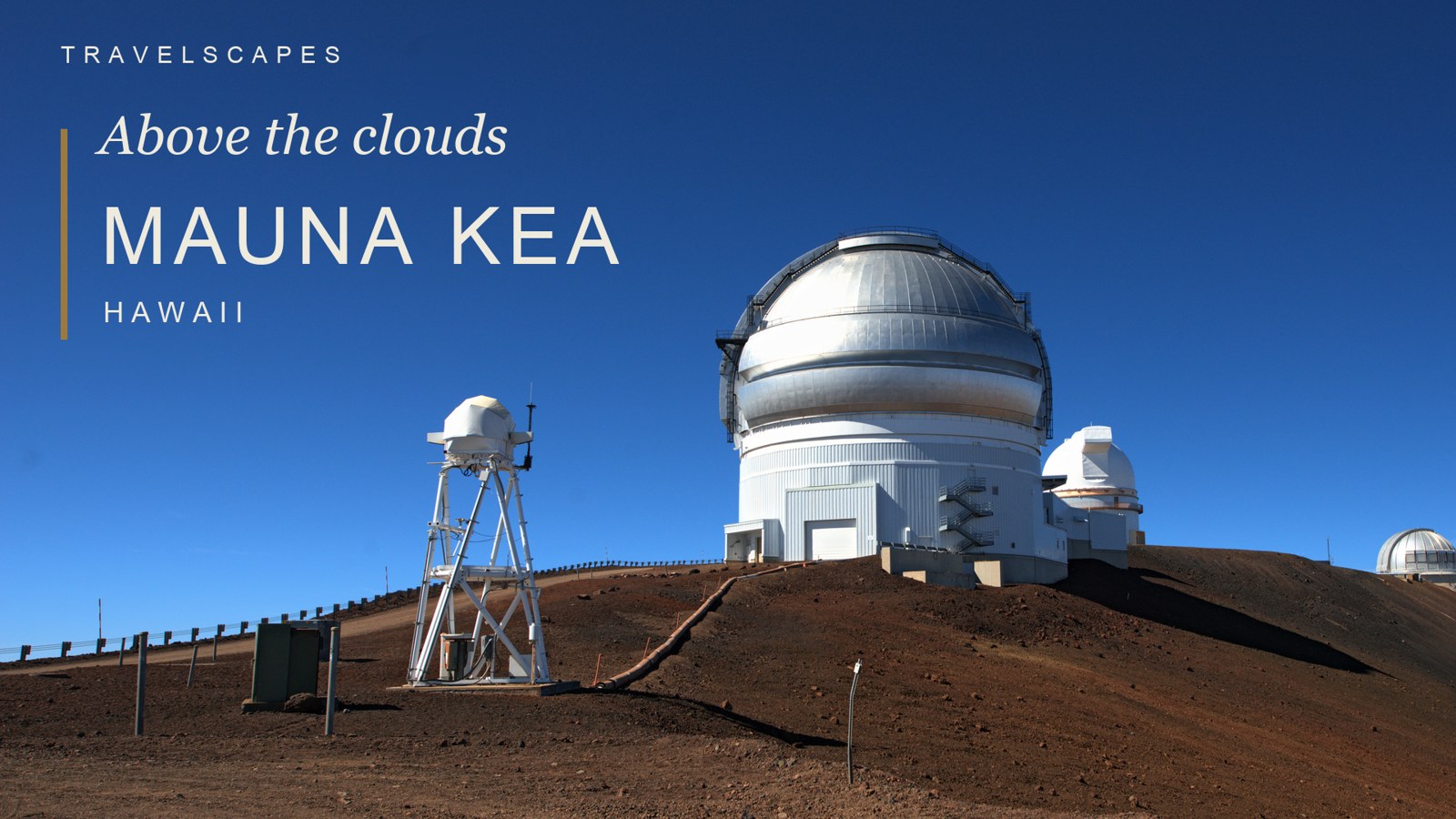
the longer we watch, the more clearly the different ridges and cones stand apart. On the upper road, the horizon begins to open. The clouds are no longer just something overhead. They become a layer below the mountain, stretching away from the slopes. Let us leave the narration for a moment, and follow this final part of the climb. The observatories bring a new set of shapes into the landscape. White domes stand against the dark ground and the blue sky. Mauna Kea’s altitude, dry air, and clear conditions make it an exceptional place to study the universe.
Much of the atmosphere lies below these telescopes, helping astronomers observe the light reaching Earth. A few steps can change the whole composition. The observatories rise above the road, while the slopes open out beyond them. Let us take a little more time to look around. Our visit stays outside the observatory buildings. From here, the wider landscape is as interesting as the structures themselves. Roads thread between volcanic ridges, while the cloud layer gathers beyond them. These are working scientific facilities, set within a mountain whose meaning reaches far beyond astronomy. Mauna Kea holds deep spiritual and cultural significance for Native Hawaiians.
Its importance is rooted in relationships between people, ancestors, and the land. Views about the mountain’s future are diverse, and its stewardship remains an important responsibility. Visiting with respect means recognising that this is more than a scenic viewpoint. Beyond the buildings, the mountain draws our attention back to the land. The dark ridges overlap against the cloud layer, and the light reveals the texture of the ground. We can pause here, and let the view speak for itself. Walking around the observatory area changes our perspective again. From the vehicle, the road carried our attention forward. Here, there is time to turn towards the ridges
and to look across the cloud layer. The scale is difficult to capture in a single frame. Moving views and still photographs each reveal a different part of it. The photographs give us a chance to linger on details that pass quickly in moving footage. The reddish brown soil, the curves of the cinder cones, and the light across the volcanic terrain all become easier to study. There is an extraordinary amount of texture in a landscape that, from a distance, can seem almost bare. For a little while, we can simply look. The domes sit on the skyline, the roads curl across the slopes, and the clouds stretch out below. No night sky is needed to appreciate this place.
In daylight, the mountain offers its own quiet sense of scale. Now we turn towards the descent. This is just a short part of the return journey, enough to see how the same landscape changes when we face the other way. The road draws us back towards the cloud layer, and the high mountain begins to recede behind us. From the climb to the observatories, Mauna Kea has shown us a remarkable side of Hawaiʻi. Thank you for travelling with Travelscapes. I’ll see you on the next road.