
Settle into the story.
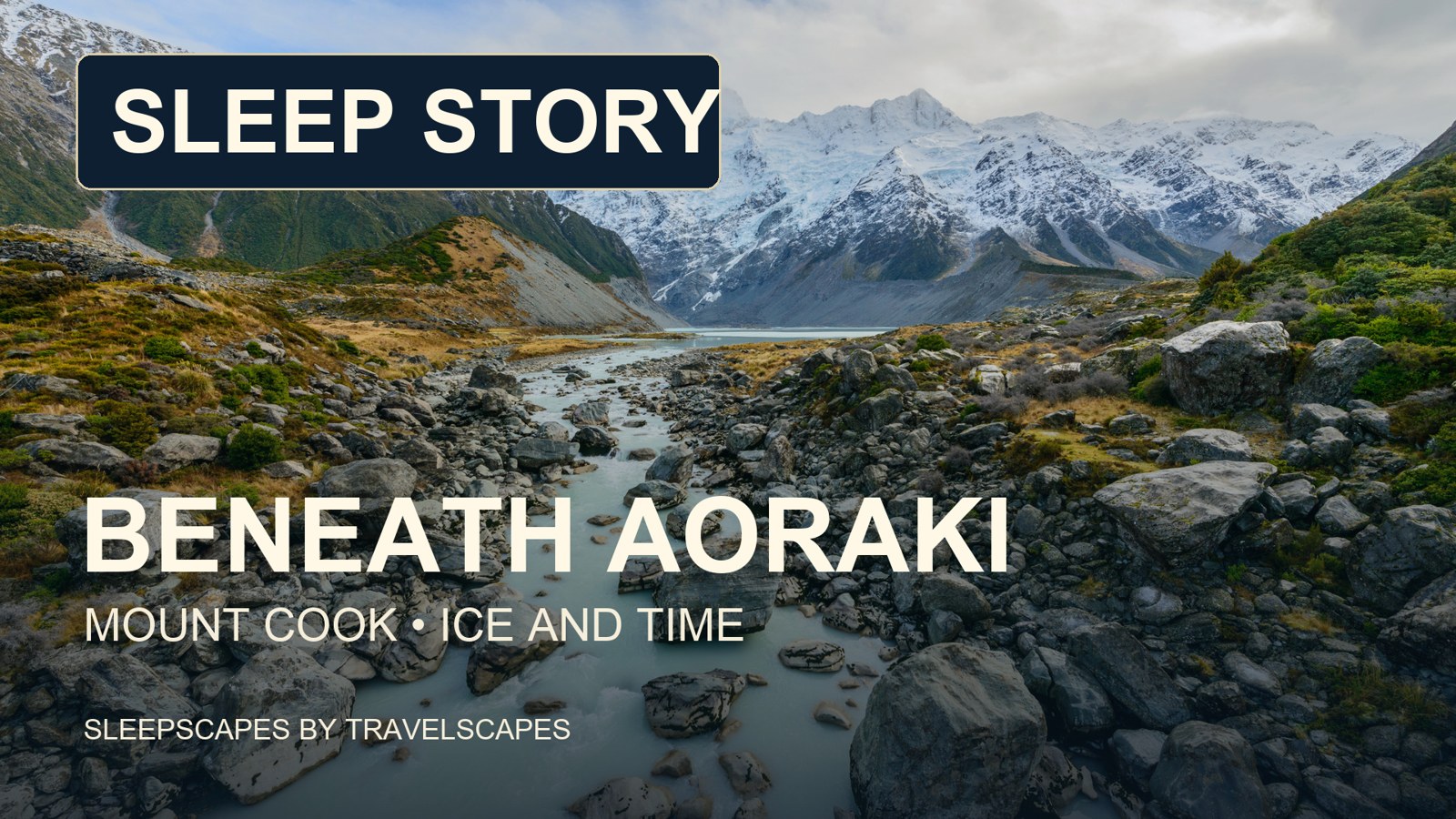
Original Travelscapes photographs accompany an imagined journey. The picture gradually dims from minute five to minute twenty-five, while the narration becomes gently slower and softer.
Original photography and footage by Sven Bannuscher. Narration uses a synthetic voice.
Chapters
Read the narration transcript
Welcome to Beneath Aoraki, a journey through ice and time. Tonight, we imagine an evening in the mountain valley, using photographs made in daylight. There is nothing to hurry toward. We can begin beside the river, and let the landscape unfold slowly. The mountains stand beyond the water, their outlines rising against an open sky. Nearer to us, the ground is broken into small shapes: a rounded stone, a narrow thread of water, a pale strip of gravel. Our imagined evening asks very little. We do not need to reach a lookout, cross a bridge, or climb higher. We can remain here, with the river passing in front of us. Let the first impression of the landscape be enough. Water, stone, and a little distance.
If your eyes close, the journey can continue through the voice alone. The photographs will gradually grow dimmer. The picture is a doorway into the valley, rather than something you must keep watching. Beyond that doorway, we can take our time. In the beginning, there may still be other things asking for your attention. An unfinished thought, a plan for another day, a small detail from somewhere else. The valley does not need to compete with them. We can let it arrive gently, one impression at a time. Perhaps you notice the pale water first. Perhaps the dark fold of the hillside. Perhaps only the space between them. There is no correct order.
This story follows a slow path, but your attention does not have to stay on that path at every moment. You may drift away from a sentence and return at the next. The landscape will still be here. We have time to find it more than once, and time to let it become familiar without asking anything of it. Picture a sheltered place beside the valley, away from the moving water. This is an imagined place of rest, rather than a route to follow. From here, the river seems to gather the space around it. One channel curves around a gravel bar. Another disappears behind a bank, then returns a little farther away. The eye can follow these separate lines without needing to choose among them. In the photograph, each detail is held still. In our imagination, the water continues.
You might notice how much of the scene is simply open space. Space between the river and the hills. Space above the ridge. Space around a single stone. We can allow the story that same room. A sentence can end, and nothing needs to take its place immediately. The valley does not become less complete when we stop describing it. It remains there, beyond the words. For a while, let the river be only a river, and the mountains be only their quiet shapes against the sky. Imagine the valley as a room whose walls are very far away. The mountain slopes rise on either side, and the sky opens above them. There is no roof to consider, only the sense of a broad place holding smaller things within it.
The river has its space. The stones have theirs. Our imagined place of rest belongs at the edge, where there is no need to disturb either one. From here, a bend in the water can be a whole scene. We can give it the attention we might otherwise give an entire journey. Then we can let that attention soften. The bend remains whether we describe it or not. You may carry its shape for a moment, like a simple line drawn in memory. And when that line fades, there is still the room of the valley around it. The mountains have a history far longer than the length of our visit. The Southern Alps have been raised through movement of the Earth’s crust, while erosion has continually worn them down. Rising and wearing away belong to the same landscape.
We need not imagine the whole process at once. Think instead of a book whose pages turn much too slowly to see. A fold appears. A ridge takes shape. Over a span of time beyond an ordinary lifetime, the shape changes again. Tonight, we see one page of that long book. The photograph does not ask us to read everything that came before it. It offers the line of a mountain, a slope catching the light, and the valley below. There is comfort in letting a very large story remain large. We can learn a little, then stop. The land does not require us to hold its entire history in mind. A single ridge is enough to bring us back to the present scene, and to the quiet place where our imagined evening began.
When we think about mountain time, even a long day becomes a small thing. Yet small things are the way we meet a landscape. A few minutes of looking. The sound of a remembered river. A photograph that brings back the colour of an afternoon. We do not need to make our experience as large as the mountain in order for it to belong. There can be a quiet balance between the immense history beyond us and the modest moment we inhabit. Tonight, that moment is enough. The ridge is there, the water below it, and our attention resting somewhere between. Imagine the mountain as a presence rather than a question. We can appreciate its shape without solving it.
We can acknowledge its long history without beginning to count the years. The story can open that distance, then leave it open. Look, in your imagination, from the distant mountain toward the stones near the river. The shapes become smaller as they come closer. A broad ridge gives way to a slope, a slope to a bank, and a bank to the little uneven ground beside us. The same scene can hold grandeur and modest details without asking us to decide which matters more. A stone may have a pale face and a darker edge. Another may be almost the colour of the water. Some details remain hidden, and we can leave them hidden. This is a journey without a collection to complete.
There is no need to count the peaks or remember every name. We can simply notice the way distance softens an outline. Far away, the mountain becomes a shape. Nearby, a stone becomes a small world of texture. Between them lies the valley, wide enough to let our attention wander, and quiet enough to let it return. For a little while, imagine the weight of a stone resting exactly where it is. It is easy to feel that a photograph ought to be examined from corner to corner. Tonight, we can look in a different way. Let one area of the scene remain clear and allow the rest to become a little less important. Perhaps the gravel bank holds your attention.
Perhaps the far ridge does. There is no need to move your attention in order to complete the picture. A landscape is not a list waiting to be finished. It is a place we encounter in fragments, at the pace available to us. In this imagined evening, the pace is gentle. The details can wait. The shape of a stone may stay with us longer than the shape of a mountain. Then the mountain may return, softly, without an announcement. We can make room for both, and for the quiet interval between them. The glacier moves slowly through the valley. Snow gathers high above, and over time becomes ice. Beneath its weight, the ice flows, carrying fragments of stone. We need not follow every grain. We can simply picture the patient movement, and the water continuing
downstream. Glaciers have helped shape the valleys of this mountain country. Their work leaves a landscape that can be read in broad forms, even when the ice itself is far away. Imagine the movement at a pace so slow that a moment seems perfectly still. Nothing in our story needs to imitate the force of that movement. We can remain with its patience. A wide valley. An open basin. A length of water leading away. The mountains and the ice belong to a story of changing shapes. Our place within it is brief, but it does not have to be hurried. We can pause at the edge of a thought, just as we paused beside the river, and let the next part arrive in its own time.
There is something useful about picturing movement that cannot be hurried. We are accustomed to journeys measured in turns, stops, and arrival times. Here, we can set those measures aside. The ice belongs to a different scale of motion. The photograph belongs to a single moment. And the story belongs to the time it takes for a voice to say a few words and become quiet again. None of these scales needs to replace the others. They can rest beside one another. If the idea of the glacier grows too large to imagine, return to one small impression. A pale surface high in the distance. A line where the valley opens.
A fragment of stone. The wider story is still there, but we do not need to carry its weight. We can leave that with the mountain. Now let your attention rest on the lake photograph. The water occupies a broad, pale space beneath the surrounding land. A bridge marks a human scale within the larger view. Its line helps the eye measure the distance, then the distance opens out again. We are not crossing that bridge tonight. We are looking from the stillness of the photograph, and imagining the evening around it. There is a difference between travelling through a place and resting with its image. Here, we have no weather to outrun, no turning to find, and no appointment
at the other end. The lake can hold our attention lightly. You can picture its nearest edge, then let the farther shore become less distinct. The image need not stay sharp in your mind. Perhaps only its pale colour remains. Perhaps only the broad space between the banks. Both are enough. If the details begin to fall away, the story can become simpler with them. A lake beneath the mountains. A valley around the lake. A quiet place from which to look. Imagine a quiet stretch of looking, with no words attached to it. The water is there, and the banks around it.
The bridge makes its slender line across the view. We do not need to turn any of these things into an instruction. They can simply remain as they are within the image. When the voice returns, it need not explain what the quiet meant. Some parts of a journey are valuable because they ask so little. A still photograph can become one of those parts when we stop searching it for the next discovery. Perhaps the lake now feels familiar. Perhaps it remains distant. Either way, we can stay with it for another moment. Let its wide shape be the whole of the scene. Beyond that shape, there is room for the imagined evening to grow softer. Water links the high country with the lower valley. In our imagined journey, we return from the lake toward the river.
We need not trace a precise route between the photographs. They are separate views, brought together here as a quiet reflection on the same mountain country. Picture a channel appearing between gravel banks. It curves away, and the curve becomes another curve beyond it. Water can be an easy thing to imagine because it does not need a final shape. It can gather, separate, and continue. The river in the photograph has its own arrangement of light and colour. Tonight, we can carry only a suggestion of that arrangement. A pale ribbon. A little shadow beside a stone. A broad bend farther out. We can leave behind the wish to see everything clearly. The story will continue without that effort.
Each sentence can make a little space, then give that space back to the quiet. The water carries on, beyond the frame, without needing us to follow. You might imagine the river as a line that continues on another page. We can see the part in front of us, but the rest belongs beyond the photograph. There is no need to turn that page tonight. The continuation can remain a possibility, rather than a route we have to take. It is enough to know that our view is only part of a larger place. The same can be true of the story. We can hear a sentence without needing to hold on to the sentence before it. We can return to the sound of the voice without finding exactly where we left.
Nothing important is waiting to test our memory. The water is still on its way, and the valley still has its space around it. Our journey can be complete without following either one to the end. Aoraki holds a profound ancestral significance for Ngāi Tahu. Ngāi Tahu are a Māori tribal people of New Zealand’s South Island. Their name means people of Tahu, after their ancestor Tahu Pōtiki. Their published account describes Aoraki and his brothers becoming the mountains, with Aoraki the highest. We acknowledge that account as a living cultural tradition, distinct from the geological description of the landscape. We are not inventing words for those ancestors, or turning their story into a personal dream. We can simply recognise that a place carries relationships as well as physical forms.
A mountain can be a familiar outline to one person, a remembered journey to another, and an ancestor within the traditions of its people. Our photographs show part of a landscape. They cannot show every meaning that belongs to it. To look thoughtfully is to leave room for what the image does not contain. Tonight, that recognition can be brief and quiet. We acknowledge the mountain, its enduring significance, and the people whose relationship with it reaches beyond our visit. Then we return to the valley, with a little more care in the way we see it. There are many ways to remember a place after leaving it. Sometimes a name carries the memory. Sometimes a photograph does. Sometimes an ordinary detail returns unexpectedly: the colour of a bank, the distance between two slopes, the shape of water seen from
above. These private memories do not contain every meaning of the land. They are a small part of the relationship a visitor may have with a place. We can hold them with gratitude, and with room for the relationships that are deeper and longer than our own. In this story, the mountain is not simply a backdrop. We acknowledge it as a place of significance, even when the words become quiet. Then we can allow that acknowledgment to rest, without turning it into another explanation. The valley remains around us, and the river leads our attention gently back toward the water. The light in the photographs belongs to the day they were made.
The evening we are imagining belongs to this story. As the picture grows dimmer, no new sunset is being added to the original landscape. We are simply allowing the screen to become less bright, while the remembered valley remains. Imagine the distant ridge becoming a gentler outline. The stones near the river lose their separate edges. The lake is no longer a collection of details, but a broad and quiet space. You do not have to keep those images in place. Let them come and go. A moment beside the lake may return to a moment beside the river. A mountain may become only the idea of a mountain. The story does not need to correct these small changes in your imagination.
We have already found the valley. There is no further destination to reach tonight. The words can grow fewer, the pauses a little longer, and the view a little softer. As the scene becomes less bright, we can release the expectation of a perfect picture. The imagined evening does not need a precise colour. It may be grey, blue, or simply a softening of outlines. The actual photograph remains unchanged in its original file. Here, the screen is only giving us less light. That is all it needs to do. We can let the image grow quiet in the same way that a sentence grows quiet when it has reached its end. No abrupt change is necessary.
The details do not vanish all at once. They become less distinct, until the idea of the valley is easier to hold than the separate things within it. A broad space. A river through that space. A mountain beyond it. The evening can remain that simple for as long as we wish. For a while, we can leave the history of the mountains behind us. Not because it has ended, but because we have followed enough of it for tonight. We have pictured the slow rise of the land, the patient movement of ice, and water finding its way through the valley. Now those thoughts can settle beside one another without becoming a lesson to remember.
You may keep one simple image: a pale river beneath a mountain. Or the lake, with its wide surface. Or a stone resting on the gravel. There is no best image to choose. The smallest detail may be the easiest companion. Let it remain only as long as it feels natural. When it fades, nothing needs to replace it. The valley can rest beyond the edge of attention. The photographs are growing dim, and the voice is growing softer. Still clear enough to follow, if you wish. Quiet enough to leave behind, if the words are no longer needed. There may still be moments when your attention becomes clear again. You notice the voice, or remember the shape of the lake, or wonder where the story has gone.
There is nothing to correct. We are still in the same quiet landscape. You can join the words again without beginning the journey over. The river offers an easy place to return. Its curve is simple, and its continuation needs no explanation. Or you may return to the stone beside the water. It asks even less. It is resting in the remembered photograph, with no destination beyond the place where it lies. Let the story become small enough to meet you wherever your attention happens to be. A few words. A little space. The faint outline of the valley, remaining beyond both.
The river continues through the valley, while the mountains remain above us. There is no need to follow it any farther tonight. A curve of water disappears beyond a bank. A line of stone leads toward the distance. The photograph holds them, and our imagination lets them move. We can allow both to be true without working at either one. There is room now for the story to become very simple. The valley remains. The water continues. The mountain has its place above the river. These are thoughts we can return to, rather than tasks we must complete. Between the words, there is a little more silence. We do not have to fill it.
If a detail returns, let it be welcome. If no detail returns, the quiet is enough. Our imagined evening has no last view to collect. We can stay where we are, while the river continues beyond us. Imagine that the last clear detail of the photograph is a narrow line of water. Around it, the banks are only suggestions. Beyond it, the mountains are a softer shape. We can let that line of water remain without trying to sharpen the rest of the scene. Soon, even the line may become less distinct. The valley does not need to be held together by our attention. It can remain somewhere beyond it, like a familiar place remembered without effort.
The story will give you no sudden sound to bring everything back into focus. Its ending will arrive gently, with room around the final words. There is no need to wait for those words. There is no need to notice exactly when the voice becomes quiet. We can allow the journey to settle at its own pace. We return to the quiet valley beneath Aoraki. The mountains need no answer from us. The river continues beyond the edge of the photograph. For now, there is only the remembered shape of the land, and a little room to rest. The picture can fade, and the valley need not disappear with it. Its outline may remain for a moment, then soften into something less distinct.
We have come through a little of the mountain’s long story. We have left room for the stories that belong to others. Now we can leave room for stillness. There is no bright farewell waiting at the end. No final instruction to hold in mind. Only the quiet continuation of the evening we imagined together. Water beyond the frame. Stone beside the water. The mountain, somewhere beyond the last clear shape. And time enough to let them go. If there is still an image with you, let it be a simple one. A bend of river. The pale space of the lake. A ridge against an open sky.
We have no more details to add. The landscape has already given the story its shape. The voice can leave it there, without asking you to remember its name or follow its history any farther. Beyond the last words, there will be a quiet tail, and a dark screen. The original photographs remain themselves, while our imagined evening comes gently to its close. We can leave the river in motion, the stones at rest, and the mountain beyond them. None needs a farewell. The valley remains a place we can return to another time. For tonight, there is room enough to rest.